


The Anthroposophical Calendar
Every Easter, Rudolf Steiner's anthroposophical Soul Calendar begins anew. Its 52 verses offer powerful riddles to awaken the soul to an experience of the Divine. It is no less than formulae for the proper evolution of humanity through the course of the year.1Rudolf Steiner, Calendar of the Soul, GA 143, 7 May 1912, Cologne. The first verse starts with Easter during the blossoming of Spring in the Northern Hemisphere.2Since it is autumn in the Southern Hemisphere, Week 27 may be a more appropriate starting point on Easter Sunday.
As Rudolf Steiner wrote in the Preface to the second edition of The Calendar of the Soul, "This Calendar contains a verse for each week that allows the soul to experience what is happening during that particular week in the context of the whole year. Each verse is intended to express what resounds in the soul when this life unites with it. The idea is to develop a healthy “feeling of oneness” with the course of nature and, as a result, a powerful “finding of oneself” based in the belief that, for the soul, a sense of empathy with the course of the world as sought in the spirit of these sayings is something the soul longs for, if it only understands itself properly."
We offer many resources for study and practice of this anthroposophical calendar.
| Preface to the First Edition, 1912/13 | ||
| Rudolf Steiner's Soul Calendar reveals in the course of world-time the rhythms of human existence that oscillate outside of time. Through practice, the human spirit can feel its own soul "weaving in the images of the impressions of the course of the year, week by week, in the moods of the seasons." | ||
| Handwritten draft verses | ||
| Rudolf Steiner's handwritten draft of the verses in German, reflecting the dates given for the first edition. These notes are classified under GA 40a. | ||
| Preface to the second edition, 1918 | ||
| Rudolf Steiner's brief summary of the purpose of the verses to awaken us to our connection to the world. | ||
| Calendar of the Soul Tool | ||
| Multiple translations and corresponding verses are updated weekly for both the Northern and Southern Hemispheres. | ||
| Formulae for Esoteric Development | ||
| Our novel translation offers pairs of corresponding verses with seven lines each to reflect the changes of the soul's striving each week throughout the year. Careful attention to the original German text reveals the Calendar's formulae for human evolution, emphasizing the polarity of spiritual and physical forces working in the human soul throughout the year. This is the only translation we are aware of that articulates the verses each with seven lines to reflect cosmic influences of Sun (Sunday), Moon (Monday), Mars (Tuesday), Mercury (Wednesday), Jupiter (Thursday), Venus (Friday), and Saturn (Saturday). | ||
Corresponding Verses
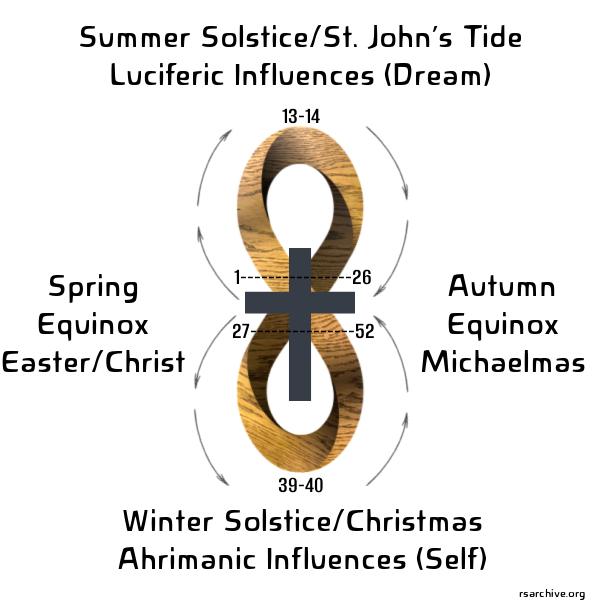
Rudolf Steiner marked each verse from Spring-Summer-Autumn (1-26) with a letter of the alphabet (a-z) and matched them with corresponding verses for Autumn-Winter-Spring (27-52). This pairing reveals a magnificent polarity of opposing forces that influence the soul striving through the seasons. Traveling the path of a lemniscate, the spring and autumn equinoxes lie at the center where the corresponding verses cross at Easter and Michaelmas. During the Summer and Winter Solstices (and then St. John's Tide and Christmas), the corresponding verses land farthest from each other.
Polarity and Practice
Like two dancing partners mirroring one another, the corresponding verses with seven inverted lines reflect two sides of an infinity pattern. They reveal the opposing Luciferic impulses of summer, on one hand, and the Ahrimanic forces of winter, on the other. Christ Jesus is centered in the middle, balancing these polar forces as depicted in Rudolf Steiner's sculpture, The Representative of Man. In the First Goetheanum, Rudolf Steiner intended to surround this central figure of the Christ with paintings and columns of cosmic forces streaming forth into the Human Being.

Thus, we have "Anthropos" or Man, Christ-Jesus, embodied here on earth (Western, material, masculine, Sun impulses) and "Sophia" or Cosmic Wisdom (Eastern, spiritual, feminine, moon impulses). Together, we have what Rudolf Steiner named, Anthroposophy: the Human Being filled with Cosmic Forces streaming forth into the world through our deeds. Published in the same year as the founding of the Anthroposophical Society in 1912, Steiner held the Calendar's intrinsic connection to all of anthroposophy required its sharing, stating: "It is not to be regarded as a sudden inspiration but as something organically connected with our whole Movement."
These formulae for meditation do in all reality lead the soul out of its narrow confines to experience of the heavens. I can assure you that the results of long, long occult investigations are contained in these 52 verses which will enable the soul to find access to happenings in the great universe and thereby to experience the Spirits working in the onward flow of Time. But if you ponder on the texts of the verses in the Calendar you will discern an element of Timelessness, in rhythmic alternation, an element that is experienced inwardly by the human being, the laws of which run parallel to those of Time in the outer world. Mere analogies do not suffice here.
See Rudolf Steiner, GA 143, May 7, 1912, Cologne.
It is a moving calendar that flows with changing dates from one Easter to the next because "in what is uniform and fixed there is the impress of death; but in what is unequal there is life." The Event of Golgotha is "the most momentous of all" since time is to be computed as beginning "on a Friday in April in the year 33 A.D. when the Mystery of Golgotha took place" and "Ego-consciousness in the present sense was actually born." Out of the ultimate death of Christ-Jesus, arose the possibility of new life in the Spirit for all of humanity. By contemplating The Calendar of the Soul verses from one Easter to the next, we bring cosmic wisdom into our souls so we may raise ourselves from this deadened world to join our true place as Human Beings as the fourth Hierarchy of Heaven.