

The Philosophy of Spiritual Activity
Outline of a Modern Worldview
Results of spiritual observation according to scientific methods.
GA 4
Rudolf Steiner's philosophical engagement with the question of individual freedom began in his youth and found striking public expression in the essay Nature and Our Ideals (1886), which Steiner later described as the “primordial cell” of the Philosophy of Spiritual Activity (Steiner's preferred English translation of the title). In the spring of 1892, Rudolf Steiner's expanded dissertation Truth and Science was published with the subtitle “Prelude to a ‘Philosophy of Spiritual Activity’”. This was followed in November 1893 by the announced Philosophy of Spiritual Activity itself (with the year of publication printed as 1894).
Among the many reactions, Eduard von Hartmann's marginal notes stand out. Rudolf Steiner had personally presented his work to this revered philosopher, who immediately studied it with keen interest. He made numerous critical marginal notes and comments, as well as underlining and highlighting passages in his copy, and sent it back to Rudolf Steiner on November 21, 1893.
As soon as Philosophy of Spiritual Activity was published, Rudolf Steiner had already thought about additions and changes for a possible second edition. After the work had been out of print for many years, Rudolf Steiner undertook a new edition in 1917, which appeared in the spring of 1918. The text was re-edited, partly on the basis of Hartmann's comments and other critiques and reviews, and with a view to improving its comprehensibility. Rudolf Steiner used a cut-open copy of the first edition as a printing template, in which he entered his additions and corrections by hand. These documents have been largely preserved and, together with all other surviving manuscript pages and documents, are reproduced in facsimile in Documents to The Philosophy of Freedom (GA 4a). This volume of documents also contains all of Eduard von Hartmann's marginal notes, as well as all known reviews, a chronicle of Philosophy of Spiritual Activity, and a list of Rudolf Steiner's statements about it.

The Philosophy of Freedom
G. P. Putnam's Sons, New York and London, 1916.
This first English translation by Prof. and Mrs. R. F. Alfred Hoernlé was based on the original 1894 German edition. It is the only translation sanctioned by Rudolf Steiner himself. The opening chapter entitled The Goal of Knowledge was removed in subsequent editions. A facsimile of pages 1-102 of the first German edition is contained in Documents to The Philosophy of Freedom (GA 4a). Therefore, we have classified the first English translation of this book as GA 4a.

The Philosophy of Spiritual Activity
Rudolf Steiner Publications, London, 1949, with 220 pp.
This is a translation of the sixth German edition. It utilized much of the original authorized translation by Prof. and Mrs. R. F. Alfred Hoernlé which was revised and amended by Hermann Poppelbaum, Phil.D.

The Philosophy of Spiritual Activity
Rudolf Steiner Publications, Inc., New York, 1963, with 411 pp. It is translated from the 2nd German edition of 1918 by Rita Stebbing, and is bound together with Truth and Knowledge.

The Philosophy of Freedom
Rudolf Steiner Press, London, 1964 with 230 pp. This English edition, was translated from the 12th German edition of 1962, and with an introduction by Michael Wilson.
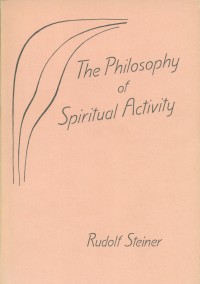
The Philosophy of Spiritual Activity
1986 edition published by the Anthroposophic Press, New York. It was translated by William Lindeman. The cover Graphic Form is by Rudolf Steiner (originally as a study for the book
Truth and Science). Layout and lettering by Peter Stebbing.

Das grundlegende Werk Steiners über das Erkennen und die menschliche Freiheit. Die Philosophie der Freiheit beweist, daß der Mensch der Freiheit — des selbstbestimmten Denkens und Handelns — fähig ist. Die Philosophie der Freiheit ist mehr als ein philosophisches Buch: sie ist ein Schulungsweg, der den Leser zur Erfahrung des lebendigen Denkens und zur Bewußtwerdung seines Geistes führt. Aus der Selbsterkenntnis des menschlichen Geistes geht eine Erneuerung des Handelns und damit der Welt hervor.
Seventeen editions: 1894, 1918, 1921, 1929, 1936, 1936, 1940, 1947, 1949, 1949, 1955, 1962/1967, 1973/1977, 1978, 1987, 1995, 2021.